Divine Mercy
The Second Sunday of Easter - Cycle A
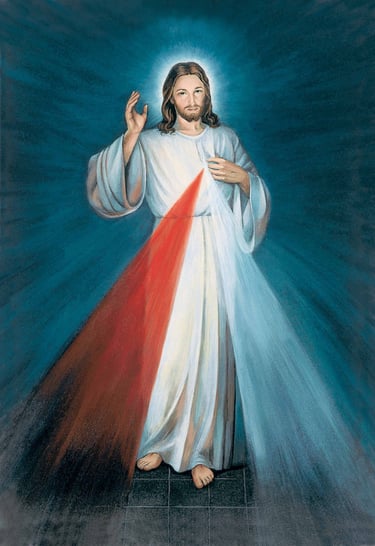
On this second Sunday of Easter, the Church celebrates Divine Mercy Sunday. In a series of revelations to St. Maria Faustina Kowalska in the 1930s, our Lord called for a special feast day to be celebrated on the Sunday after Easter. Today, we know that feast as Divine Mercy Sunday, named by Pope St. John Paul II at the canonization of St. Faustina on April 30, 2000.
Divine Mercy Sunday is a day of extraordinary grace.
“Ordinarily, only the sacrament of Baptism effects in the soul the complete forgiveness of sins and punishment.' Reception of the Eucharist in a state of grace ordinarily remits only venial sin, strengthening the soul against both venial and mortal sin. But on Divine Mercy Sunday, reception of Holy Communion worthily and with trust in God's Mercy pours out upon the soul a complete renewal of baptismal grace.” Rev. Ignacy Rozycki, STD, Former Member of the Holy See's International Commission.
To receive a plenary indulgence and the special graces of Divine Mercy Sunday:
Place complete trust in God's mercy
Repent of all your sins and go to Confession within a reasonable time before or on the Feast (during Lent suffices)
Celebrate God's mercy by attending Mass and receiving Holy Communion on Divine Mercy Sunday or the anticipatory Mass
Venerate the image of The Divine Mercy
Be merciful to others, by our actions, words, or prayers.
“Blessed are those who have not seen and have believed.”
Thomas is often given a bad rap for being the doubting Disciple, but that first Easter Sunday found all of the Disciples cowering in fear in the upper room because none of them believed in what Jesus had promised. Peter and John raced to the tomb to see if Mary Magdaline’s announcement of the risen Christ could be true. Other disciples left for Emmaus feeling betrayed and lost. When the Lord appeared to them in the upper room the first thing he did was show them his wounds. He did same thing for Thomas a week later. Jesus carried the wounds of the crucifixion on his glorified body so that they could see and believe.
70% of Catholics have ceased to believe in the real presence of Jesus in the Eucharist because we cannot see anything greater than just bread and wine. Like Thomas, we demand proof. So, Jesus gives us Eucharistic miracles where consecrated hosts turn to flesh, more specifically, heart tissue. If these Eucharistic miracles tell us anything it is that when we hold the Eucharist, we don’t simply hold a piece of bread, we hold the very heart of Jesus. Ask any parent where their heart is and they will tell you it is with their children. When we hold the Eucharist, we don’t only hold the heart of Jesus, but we hold the heart of the Father as well. We get to hold the heart of the heart of God at every Mass. Do not be a doubting Thomas. Believe Jesus when he says, “This is my body. This is my blood.” through the priest in the words of consecration.
My heart is full because the tomb is empty.
Evangelizing Worldwide
© 2025. All rights reserved.
Contact Me