Lesson 6 - The Pascal Mystery
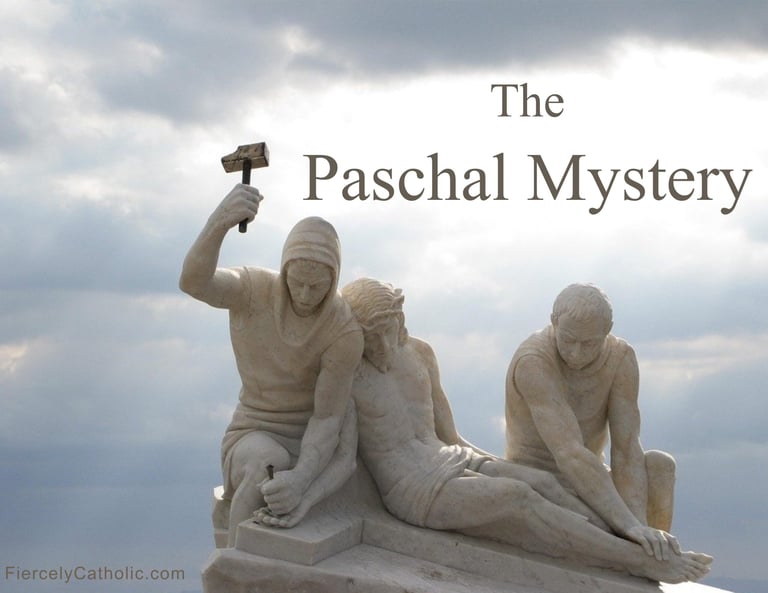
We hear the term Pascal Mystery, but what exactly does it mean? First, we have to understand the word mystery. When we hear the word mystery, we think of a “who done it”. Mystery comes to us through the Greek and means, “A thing whispered”. We translate it to mean a secret. Mysteries are beliefs that we accept as truth on faith alone because they have been revealed to us by God.
The word pascal comes to us through Hebrew and means “passover”. The Passover was the last plague God sent into Egypt when he was trying to convince Pharoh to release the Hebrews from captivity. It began with a sacred meal where a lamb was sacrificed by each house. That lamb was eaten in a prescribed manor and its blood was put on the door posts of the Hebrew houses. Then God sent the angel of death into Egypt to kill the first born of every creature, man and beast alike. This included the only son of the Pharoh.
The angel of death passed over any house that had the blood of the lamb on the door posts, sparing the Hebrews from the plague. Pharoh, distraught from the death of his only son, released the Hebrews from their captivity. God himself led them away from Egypt. God then turned Pharoh’s heart hard and he ordered his army to pursue and kill every single person. God led his people dry shod through the Red Sea. When the Egyptians tried to pursue them, the Red Sea came crashing down and killed them all.
The sacrificing of a lamb became the means of their salvation and deliverance from captivity. But man was still a slave to death so God, in much the same way, sent his son to be our pascal lamb to free us from the slavery to death. The essence of our faith is this: that Jesus came to die for us, to free us from our sin, so that we might have eternal life.
When we are talking about the Pascal Mystery, we are referring to God’s plan of salvation, which was ultimately fulfilled through four events in Christ’s life. Those events are his Passion, death, resurrection, and ascension into heaven.
Let’s take a step back and ask why Jesus’s sacrifice was necessary. Couldn’t God being all powerful just snap his fingers and forgive our sins? He is God, so he can do whatever he wants. But God is love and for love to exist there has to be a choice. The choice to be forgiven has to be made by us for it to be effective. Jesus’ sacrifice opened the gates of heaven that were shut by the disobedience of man. It is our choice to walk through those gates or turn from them.
In our lesson on the Holy Sacrifice of the Mass we learned that a covenant with God requires a blood sacrifice. There are some conditions and elements for a sacrifice to be valid. There has to be a visible gift. The sacrifice has to be offered by an authorized person. The sacrifice has to be offered up to God and the offering must be destroyed in some way. In the Passover, a lamb was sacrificed by the priests and eaten by each household. The blood of the lamb was put on the doorposts as the sign of the covenant so the angel of death would pass over the house and spare all in the house from the punishment of death.
Jesus is known as the Lamb of God. He is our Pascal sacrifice. The visible gift is Christ’s body, blood, soul, and divinity, offered as a gift to God by Jesus himself. This gift is destroyed when we consume it in the Holy Eucharist. When we enter into this covenant with God, death has no hold on us and we can enter into heaven to live in intimate relationship with God for all eternity.
The Pascal Mystery is what separates Catholics from every Protestant denomination. They are incapable of offering sacrifice because they lack the authority to consecrate a host. Without a consecrated host they do not have a valid gift to offer or consume, which are requirements of the covenant. Their services are nothing more than an instruction of the faithful. They would say that Jesus’s one sacrifice covers all people throughout time and that is true. However, entering into this new covenant with God is a choice every person has to make for themselves. You enter into this covenant when you participate in the covenant, which requires consuming the sacrifice. The Catholic Mass is not a repeat performance of Christ’s sacrifice on Calvary. Christ’s sacrifice on Calvary is made present to us in our time and in our place so that we may enter into covenant with God by participating in the Pascal Mystery.
Redemptive Suffering
One of the most common questions asked to Christians is; if God is all powerful and all loving why is there suffering in this world. If he loves us as much as we are told, why doesn’t he just snap his fingers and make all suffering go away? Those are fair questions.
In the beginning when God created the earth there was no suffering. There was no illness. There was no death. There was no hunger, hate, or violence. God created the world to be good, but it was not perfect. The world was created in six days, which is the Jewish number for imperfection. All of God’s creation was deemed good except for the second day. The second day was the day that God separated the heaven from the earth and it is the only day that God did not say that it was good. The separation from heaven was not good, but it was necessary.
When God created the angels, he created them for service. They were created with full knowledge of who God is. They were given free will to serve God or to reject him. They get to make that choice one time in the beginning and their choice is binding for all eternity. An angel who chooses to reject God can never be redeemed.
God went a different route when he created humans. We were created to be loved. God instilled in our hearts the desire to know him, but he gave us no knowledge of who he is. He then reveals himself to us so that we can come to know him and in turn to love him in return.
It is written that death came into the world through the envy of the devil. The devil was the greatest of the angels. He was the bearer of light. What could he possibly be envious of from us mere humans? First, God created us in his image and likeness. The angels were not created in God’s likeness. Second, God created us to be loved and the devil was created to serve. He found this to be beneath his dignity. He was the greater creature and humans should be serving him. Third, God gave man something he gave no other creature, including the angels. God shared with man the ability to create an immortal life. When husband and wife come together to form a one-flesh union we call a child, God infuses into that child an immortal soul. This is why the devil hates life and has done everything he can to get us to turn from it and destroy it wherever he can.
God is perfect sacrificial love. Love can never be forced. For love to exist there must be a choice. To make it possible for us to love God we have to have the choice of not loving God. If this world were made perfect, we wouldn’t have that choice because we would have to depend on God for everything. This is why God put into the middle of his creation the tree of good and evil. He gave man the choice to love him and do as he asks or we could eat from the tree and die.
The devil convinced man that he would not die but that they would be like God instead. Man ate of the tree and through the disobedience of our first parents, death and suffering entered the world. Death and suffering were never God’s plan for us. God is neither impressed by our suffering, nor is he happy when we do suffer. Instead, out of his sacrificial love for us he promised that in the fullness of time he would send a savior who would redeem us to what we had lost.
Sacrificial love is the greatest of all forms of love. It is a love that gives everything it has without demand for something in return. Suffering is the currency of love. In this life we show how much we love someone by how much we are willing to suffer for them. I have not met a parent who has not desired to take on a sick child’s suffering so they wouldn’t have to bear it. I have not met a parent who was not willing to offer their life in exchange for child who was facing death. This is the kind of love we are called to have for one another. This is the kind of love God has for us.
One of the hardest things anyone has to do is to minister to someone who is sick, especially if they are dying. It is very common, especially among men, to feel as if we are a burden to everyone when we are sick. We feel ashamed that we have to be cared for. We feel inadequate because we can’t provide as we once did. What is important to realize, when we suffer, we become a conduit through which God’s grace flows to those who care for us in love. Suffering is the currency of love and love is never wasted with God, who is love itself. When we allow others to care for us, we allow God’s grace to flow through us to them, giving them the strength they need to do what they do.
We as a society do everything we can to get out of and avoid suffering. Wake up with a little pain? There’s a pill for that. Do you find yourself low at the end of the day? Perhaps you can find some relief in the bottom of a bottle or now a days maybe a gummy. The ultimate end of this road comes in the form of euthanasia. If you have a terminal illness there is no need for you to go through all of the agony that comes with it. You can choose to end your life on your terms. This is an idea that is becoming more and more popular in our society. They will try to sell it as death with dignity and make it sound like a good thing.
As Catholics we believe in something very different. We believe in redemptive suffering. Redeem is a word that means to buy back. If suffering is the currency of love, then it is the currency used to buy back that which has been lost. When man was disobedient to God, death came into the world and claimed man for itself. All mankind became a slave to death. Our sins cause an infinite chasm between us and God. A chasm that we can never fill. Only the infinite can fill the infinite. God planned from the beginning of time to send his son to be, not only our salvation, that is to save us from death, but to also be our redemption. Jesus pays back for us a debt we cannot pay for ourselves. He did this by offering himself in our place.
Through the suffering, death, and resurrection of Jesus we have been saved from death and redeemed from the wages of sin. Mankind is not only restored to what we were in the garden, but at the end of time what we were meant to be from the beginning will be fulfilled when we receive glorified bodies in heaven. Jesus’ crucifixion was the ultimate sacrifice made out of love for us. We have a God who loves us so fully that he was willing to become one of us to bear all of the suffering we deserve so he could buy us back from death so that we can love him forever in eternity.
So why do we still have suffering in this life? We are told by St. Paul in Colossians 1:24 that we make up in our bodies that which is lacking in the crucifixion of Christ. What can possibly be lacking in the sufferings of Christ? Quite simply our participation in it. We get the opportunity to offer our sufferings, our works, joys, and all that we are as part of Christ’s sacrifice. He takes it all and blesses it, uses it, makes it all good, and returns it to us as his grace. We are bound to Jesus’s suffering and death so we can be bound to him in his resurrection and life.
Here's the catch. God allows us to keep our suffering for ourselves. We are not required to participate in the crucifixion of Jesus. If suffering is the currency of love and we are not willing to attach our suffering to the suffering of Jesus for the redemption of the world, we keep our suffering for the love of self. An eternity in hell awaits those who choose love of self over love of God. If we are not uniting our suffering to the cross, our suffering is in vain.
Think of it like this – When we sin, we take on an infinite debt to death. Suffering, the currency of love, is what we use to pay back that debit. We can never pay back the debit on our own. Jesus makes up that which we cannot pay back ourselves. If we do not do our part to pay this debt we default on the loan and death gets to claim us for its own.
Mass is the celebration of the Pascal Mystery. We remember and proclaim this mystery of faith when we proclaim, “Save us savior of the world. For by your cross and resurrection you have set us free.” Notice that in this affirmation of faith we say, “Save us.” We don’t say, “Save me.” This is not about Jesus and me. This is about Jesus and all of creation. Jesus wants a family, not a drinking buddy. The Pascal Mystery reminds us that we are not to be concerned just our own salvation, but that of the whole world.
So, what is our role in God’s saving plan? How do we best join in the Pascal Mystery? Before Jesus returned to heaven he gave his Apostles the great commissioning. “Go therefore, and make disciples of all nations, baptizing them in the name of the Father and of the Son, and of the Holy Spirit, teaching them to observe all I have commanded you.”
Jesus left us with two commands. Love God first, with all our heart, mind, soul, and strength, and to love one another with that same love. This doesn’t mean that we run around baptizing everyone we see or telling them if they don’t accept Jesus as their Lord and Savior they are going to hell. What this means is that we live our lives sacrificially for one another. We suffer for one another. You may be the only bible someone reads. You may be the only face of Christ they will ever look upon. Be the best version of that you can.
Evangelizing Worldwide
© 2025. All rights reserved.
Contact Me