The Holy Spirit
The Holy Breath of God


Prayer to the Holy Spirit
Come Holy Spirit, fill the hearts of your faithful
and kindle in them the fire of your love.
Send forth your Spirit and they shall be created.
And You shall renew the face of the earth.
O, God, who by the light of the Holy Spirit,
did instruct the hearts of the faithful,
Grant that by the same Holy Spirit we may be truly wise
and ever enjoy His consolations,
Through Christ Our Lord, Amen.


The Holy Spirit is the third person of the Trinity. Let us review – we have only one God. This one God reveals himself to us in three individual and distinct persons. The first person of God is God the Father. The second person of God is God the Son, who in the fullness of time became incarnate and is known as Jesus. The third person of God is God the Holy Spirit.


The Greek word used in the bible for the Holy Spirit is pneuma. It is from that root that we get words like pneumatic and pneumonia. Pneuma deals with the movement of air. In the bible the word pneuma translated as either wind or spirit. A more precise translation of the word is breath. The Holy Spirit is the Holy breath of God. Anywhere you read the word wind or spirit you can translate it the breath of God.


In the second chapter of Genesis we read, “Then the LORD God formed the man of dust from the ground, and breathed into his nostrils the breath of life; and the man became a living person.”
The Father breathed the Holy Spirit into the nostrils of man and brought us to life. There are only two times in the bible where it mentions God breathing on people. The first is when God created man as we have just heard. The second is when Jesus passes his authority on to his priests.
In the gospel of John we read,” So Jesus said to them again, “Peace be to you; just as the Father has sent Me, I also send you.” And when He had said this, He breathed on them and said to them, “Receive the Holy Spirit.”
Before time began, God the Father used his Holy Breath to say one Word. That Word was Jesus, and through him all things were created.


In our creed we state, “I believe in the Holy Spirit, the Lord, the giver of life, who proceeds from the Father and the Son, who with the Father and the Son is adored and glorified, who has spoken through the prophets.”
The Holy Spirit is the love that is shared between the Father and the Son. That love is so real that it manifests itself as a person. The Holy Spirit comes forth from the Father and the Son and turns their wills into actions.


The Holy Spirit is typically the first person of God we encounter. The Holy Spirit is given to us in baptism and manifests himself fully in our confirmation. It is the role of the Holy Spirit to kindle within us the grace needed in order to come to know and love Jesus as our Lord and savior and the Father as our father. The Holy Spirit is what makes us who we are as Christians.
The Holy Spirit also has the unique role of animating the Church in our day and age. The “Church” here means everyone who is alive in Christ. Everyone who has grace in their lives. Everyone following the will of the Father and living out their Christian dignity as sons and daughters of God. The Holy Spirit makes this happen in a perfect and orchestrated way.


“I will ask the Father, and He will give you another Helper, so that He may be with you forever; the Helper is the Spirit of truth, whom the world cannot receive, because it does not see Him or know Him; but you know Him because He remains with you and will be in you.” – John 14:16-17
Before Jesus ascended back into heaven he promised to send the paraclete. In Greek, a paraclete was council for the defense in a legal trial. He would whisper in the ear of the accused what he should say in his defense. A paraclete is an advocate, a helper, a consoler, or a comforter. The Holy Spirit is the paraclete Jesus promised to send after he ascended back to heaven.


Images of the Holy Spirit
There are many ways the Holy Spirit has been revealed to us throughout the ages. There have been many images of the Holy Spirit used in Scripture. Each one of these images reveals a unique characteristic of the Holy Spirit. Here are some of those images:


Water: Water signifies the Holy Spirit in that it is poured and cleanses. It is poured at baptism, and the Holy Spirit is subsequently poured in that act. Water also signifies death to sin. This is seen in the story of Noah and the flood as well as in the story of the Red Sea when water destroyed the Egyptian army.


Anointing: The symbol of anointing with oil also signifies an outpouring of the Holy Spirit. We see this in several of the sacraments (Baptism, Confirmation, Anointing of the Sick, and Holy Orders). Also, the prophets were anointed with oil to symbolize the outpouring of the Holy Spirit on them for their ministry.


Fire: Fire transforms that which it touches. It symbolizes power, energy and transformation. It was “tongues as of fire” that descended upon the Apostles at Pentecost.


Cloud and light: We see these images in the Old and New Testament. Jesus was transfigured in light. Mary was overshadowed by the Holy Spirit. It was a pillar of cloud by day and a pillar of fire by night that led the Israelites through the desert. The cloud is a masking and veiling of the presence of the Spirit, and the light is but a small portion of the radiance of the Holy Spirit shining forth.


Seal: To be marked or sealed with God is an action of the Holy Spirit. We say, for example, in Confirmation that there is an indelible character, a spiritual character, a seal, that is impressed upon one’s soul. This is a marking of God and a sign of the presence of the Holy Spirit.
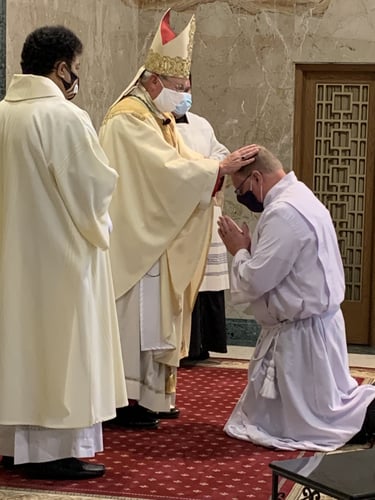
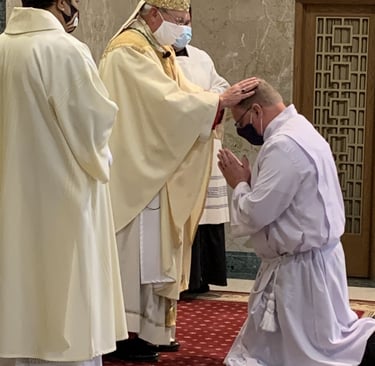
Hand: The laying on of hands is a sign of the outpouring of the Holy Spirit. This is seen in Baptism, Confirmation, Ordination, and the Anointing of the Sick. We also recall that Jesus laid hands on the sick to cure them.


Finger: It was by the “finger” of God that Jesus did many great works. This shows the Holy Spirit at work in Jesus’ ministry. It was the finger of God that gave us the Ten Commandments. And it is by the finger of God that the Holy Spirit continues to work in our day and age.


Dove: Perhaps this is the most common symbol of the Holy Spirit. The dove was present with Noah at the ark, the dove descended upon Jesus at His baptism. White is a symbol of purity, and its wings give it swiftness and agility to descend from the Heavens.


The Holy Spirit’s Activity in Salvation History
The Holy Spirit has been around from before the beginning of time and has been made manifest throughout the history of our Universe. Let’s look at the various ways the Holy Spirit has been at work:
Creation: The Spirit breathed on the waters at the beginning of Creation and is responsible for the principle of life. If you think hard about it, you’ll discover that “life” is hard to define. What actually gives life? What sustains life? Be it plants, animals or humans, no scientific discovery can unmask the actual principle of life itself. Much can be said about living creatures and how they work from a scientific perspective. But why they work is another question. And the answer is the Holy Spirit who animates and sustains all life.
Promise, Theophanies, and the Law: God spoke to Moses, Joshua and the great prophets in various ways. These manifestations of God’s presence are theophanies. The law, given through Moses, was also a manifestation of God’s order and direction. All of these point to the promise of God’s future gift of salvation. A theophany is a manifestation of God, by the working of the Holy Spirit, pointing to the promise of God that will ultimately be fulfilled by the Holy Spirit.
Kingdom: The kingdoms of the Old Testament also pointed to the promise of the one eternal Kingdom which would be established by Christ and orchestrated by the Holy Spirit. These O.T. kingdoms would fall as people failed to live by the law which was revealed by the Spirit. Thus, their inability to keep the law was a sign they needed more. They needed the fullness of the outpouring of the Holy Spirit. This pointed over and over again to the need for a Messiah. That Messiah would come and, in the end, bestow the Holy Spirit.
John the Baptist: John was “filled with the Holy Spirit” from his mother’s womb. He was the greatest of the prophets who spoke with the anointing of the Spirit of God. It is by John’s hand that Jesus was baptized after which the Holy Spirit descended in manifest form.
Our Blessed Mother: The Holy Spirit prepared Mary with a special preservative grace. This grace was given by a special working of the Holy Spirit by applying the merits of her Son’s death and Resurrection to her at the moment of her conception. She then lived her early life filled with the Holy Spirit. At the Annunciation, Mary conceived her Savior, and the Savior of the whole world, “by the power of the Holy Spirit.”
Jesus: Jesus is the “Anointed One.” He is filled with the Holy Spirit and one with the Holy Spirit. At His baptism, the Spirit descends in fullness upon Him. Not that the Holy Spirit wasn’t already with Him fully. Rather, this was a manifestation of the Spirit who was already with Jesus revealing this reality. Jesus promised His Advocate, the Holy Spirit, to His disciples. In the end, at His death He “gave up His Spirit.” And after His Resurrection He breathed the Spirit on the Apostles and promised to send His Spirit on all as He was preparing to ascend into Heaven.
Pentecost: Pentecost is the clearest manifestation of the Holy Spirit. As the disciples are gathered in the upper room, tongues as of fire descend upon them, and they are filled with the Holy Spirit. They receive various charisms and are given a new strength and boldness to proclaim the Gospel.
Church: At Pentecost the Church is born. We see the Holy Spirit alive in various ways in the Church today. As outlined earlier in this Chapter, the Holy Spirit is the one teaching through the bishops, sanctifying us through prayer and the sacraments, and spreading the Good News through the apostolic works of the Church.


The Seven Gifts of the Holy Spirit
Central to Catholic teaching are the seven gifts of the Holy Spirit: wisdom, understanding, counsel, fortitude, knowledge, piety, and fear of the Lord. These gifts are bestowed upon Christians to aid them in living a virtuous and faithful life.
Wisdom – an understanding in our inner being, which enables us to see God’s viewpoint or vision of the world. It helps us develop the ability to make judgments about everything in our lives on the basis of a deep, personal union with the Lord and his abiding love.
Understanding – enlightenment of our minds and hearts with divine truth so that we can grasp the mysteries of the Lord. This gift enables us to see the Lord more deeply. It also illuminates the Holy Scriptures as we read them and gives us knowledge of God and his ways. Signs of this gift are new insight into the Scriptures, increased depth in prayer, and renewed appreciation of the sacraments.
Counsel (Right Judgment) – the ability to receive and/or give good advice. It empowers us to make decisions in the Spirit in practical life situations and allows for maturity as we grow in our Christian walk. Sometimes it takes place in the sacrament of Reconciliation. The Holy Spirit helps us discern good from evil, right from wrong. We grow in this gift by humbling ourselves to seek help from others when faced with a difficult situation.
Fortitude (Courage / Strength / Zeal) – enables us to face with strength the trials and dangers we encounter in our Christian life. It empowers us to choose consistently the right way to live in spite of disappointments and difficulties. We can grow in courage by resisting the temptations of the world: money, power, self-centeredness, and self-righteousness. It is often seen as the root of the charism of evangelism.
Knowledge – is having a deep trust and sureness about the Lord and knowing the truths of Christian revelation. This gift of the Holy Spirit produces in us a deep trust and sureness about the Lord. We grow in the gift of knowledge through daily study of the scriptures and the teachings of the Church.
Piety (Love) – called in Romans 8:15 the "spirit of adoption" produces in us a loving and worshipful consciousness of God as our Father. Piety leads us to a true image of our Father as merciful, faithful, abounding in steadfast love, slow to anger – but also firm and just. It also helps us to see God’s holiness reflected in other people and to love them. We grow in piety through the practice of justice, attitudes of cooperation with authority, truthfulness, friendliness, and humility.
Fear of the Lord – an attitude of reverence and awe in the presence of God. It is not to be confused with the emotion of fear. However, fear of offending God is a manifestation of our reverence and respect for WHO GOD IS. This gift enables us to reverence all life as a reflection of God’s life. We grow in reverence by praying to God often, by being thankful for God’s gifts, and by respecting God’s name. Fear of the Lord is the spiritual door to the full Christian life, a great aid in overcoming sin in our lives. (See Psalm 111:10; Proverbs 9:10; Psalm 34:12-15)


The Fruits of the Holy Spirit
In addition to the gifts, there are twelve fruits of the Holy Spirit prophesied by Isaiah and reiterated in the New Testament by Saint Paul in his Letter to the Galatians: love, joy, peace, patience, kindness, goodness, faithfulness, gentleness, self-control, modesty, chastity, and generosity. These fruits emerge as signs of a Christian’s life in alignment with the Holy Spirit.
Charity or Love - Charity is the love of God and neighbor, without any thought of receiving something in return. However, it is not a "warm and fuzzy" feeling; charity is expressed in concrete action toward God and our fellow man.
Joy - Joy isn't emotional in the sense that we commonly think of joy; rather, it is the state of being undisturbed by the negative things in life.
Peace - Peace is a tranquility in our souls that comes from relying on God. Rather than getting caught up in anxiety about the future, Christians, through the prompting of the Holy Spirit, trust God to provide for them.
Patience - Patience is the ability to bear the imperfections of other people. It comes from a knowledge of our own imperfections and our need for God's mercy and forgiveness.
Kindness - Kindness is the willingness to give to others above and beyond what we owe them.
Goodness - Goodness is the avoidance of evil and the embrace of what's right, even at the expense of one's earthly fame and fortune.
Generosity - Generosity is a bigheartedness grounded in an abundance mentality. It is unselfish and expresses itself in sharing. It is extended to family and friends, strangers, and particularly those in need, and is offered not only as money, food and clothing, but also as time shared and assistance provided.
Gentleness - To be mild in behavior is to be forgiving rather than angry, gracious rather than vengeful. The gentle person is meek, like Christ Himself, Who said, "I am gentle and humble of heart" (Matthew 11:29). He does not insist on having His own way but yields to others for the sake of the Kingdom of God.
Faith - Faith, as a fruit of the Holy Spirit, means living our life in accordance with God's will at all times.
Modesty - Being modest means humbling yourself and acknowledging that your successes, achievements, talents, or merits are not truly your own but gifts from God.
Self-Control - Continence is self-control or temperance. It does not mean denying oneself what one needs or even necessarily what one wants (so long as what one wants is something good); rather, it is the exercise of moderation in all things.
Chastity - Chastity is the submission of physical desire to right reason, subjugating it to one's spiritual nature. Chastity means indulging our bodily desires only within the appropriate contexts—for instance, engaging in sexual activity only within marriage.


Manifestations of the Holy Spirit
There are nine ways that the Holy Spirit manifests himself in our lives. These are supernatural manifestations and not normal occurrences. Not every person will receive these gifts. They are given to bring about God’s will and not for personal use. These gifts are: knowledge, wisdom, discernment of spirits, speaking in tongues, interpretation of tongues, prophesy, faith, healing, miracles
Knowledge - a supernatural revelation of facts past, present, or future which we did not learn through the efforts of the natural mind – this is not to be confused with the knowledge we have acquired through the study of scriptures.
Wisdom - a supernatural insight given to the members of the Body of Christ which reveals God’s timing and method of ministry in a given situation. It explains or illuminates a given revelation such as a word of knowledge, discernment of spirit or the communication of revealed prophecy. This is not the same as wisdom we gain from our experiences in life or intellectual pursuits. It is not to be confused with the virtue of wisdom.
Discernment of Spirits – a supernatural ability to recognize whether a person or situation is being motivated by the Holy Spirit, their human spirit, an evil spirit or a combination of these spirits. The discernment of spirits is NOT everyday discernment used for making decisions, nor an insight into human nature that one might naturally possess, nor an adept ability to suspect something wrong in the motive of others. It is NOT the natural ability to assess situations. The discernment of spirits is a supernatural gift of revelation given for a specific situation.
Speaking in Tongues – a spontaneous, inspired utterance by the Holy Spirit in which we use our voice according to the Spirit’s prompting. To speak or sing in Tongues or "to pray in the Spirit," as it’s called, is what happens when a believer allows the indwelling Spirit to guide and form the words they utter. To pray, to speak or to sing in Tongues is to pray in what could be an earthly or heavenly language; a language current on the earth or one long dead, or it could be any one of countless dialects. Praying in tongues brings deliverance, inspiration, refreshment (both spiritually and physically), revival, wisdom and is a means to victory in spiritual warfare.
The gift of tongues is considered the "least" of the gifts, even though it is often presented as a very important manifestation of the baptism in the Spirit. It is the ‘gateway’ gift to the other gifts. If we humble ourselves in our relationship with the Lord so much as to yield to His Holy Spirit within us in order to ‘babble’ in a ‘strange tongue’, then we open ourselves so much more to surrender to the other gifts to be manifest in us for the good of the Church.
Interpretation of tongues – a prophetic message given in response to God’s signal of ‘speaking in tongues’. If someone ‘speaks’ out in a tongue, there ought to be an ‘interpretation’.
Prophesy – a supernatural communication from God to an individual or a group of believers. All prophesy is imperfect. Saint Paul tells us we know in part – we prophesy in part
Faith – a supernatural outpouring or anointing of the Holy Spirit which enables us to confidently believe without a doubt that what is spoken or undertaken in Jesus’ name will be accomplished. Faith involves entrusting oneself wholly to God and to believe absolutely and completely what He reveals.
Healing – supernatural outpourings of God’s power which results in the healing of sickness and disease without the use of medical means. This can involve "sickness" of the body, soul and/or spirit.
Miracles – Miracles are interventions into the course of events which seem to contradict the so-called laws of nature. Through ‘working of miracles’ the Holy Spirit manifests the power of God to produce works which go beyond the natural.
Evangelizing Worldwide
© 2025. All rights reserved.


Contact Me